Nathan VanSteenkiste ‘26, Copy Editor
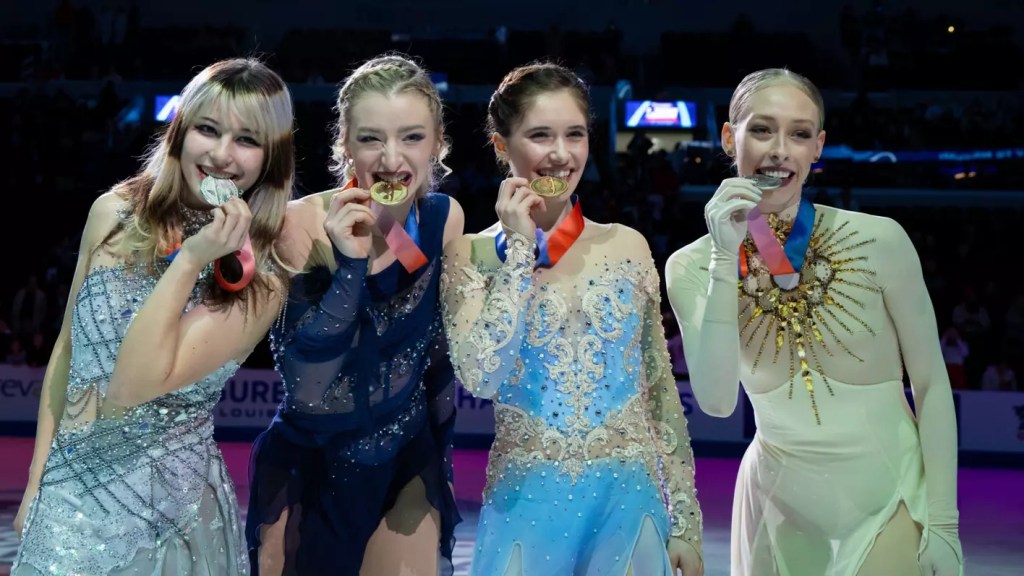
For the second consecutive Olympics, the U.S. won gold in the figure skating team competition, besting Japan by a single point, and it truly was a group effort, as each point was crucial in securing victory in what was a two-horse race for the top spot on the podium.
Introduced in 2014, the team competition pits the ten best figure skating countries against each other. In the preliminary round, each country enters a short program from each of the four disciplines—men’s individual, women’s individual, pairs, and ice dance. For each discipline, the performances are scored and ranked—with first place earning 10 points, second place earning nine points, and so on. After the four short programs, the cumulative scores are determined, and the top five countries advance to the finals, with their scores carrying over.
In the rhythm dance for the U.S., Madison Chock and Evan Bates dominated the competition, perfectly executing their program and scoring a season’s best 91.06. Meanwhile, the Japanese, who are notoriously less competitive in ice dance, finished in eighth place and only contributed three points for their team.
In the pairs’ short program, the inverse occurred, as the Japanese are particularly skilled in this discipline. Americans Ellie Kam and Danny O’Shea delivered a strong program, recovering well from an early fall, placing them in fifth and earning six points. But the team’s lead took a hit after Japanese skaters Riku Miura and Ryuichi Kihara easily won the short program and ten points.
Eventual women’s individual gold medalist, Alysa Liu, had a strong performance of her popular “Promise” program, contributing nine points with her short program and finishing just behind Japanese veteran Kaori Sakamoto. And although many were surprised that he came out a bit shaky and did not win the short program as expected, the ‘Quad God,’ Ilia Malinin, still finished in second and added nine points for the U.S., securing a one-point lead heading into the finals.
Once again, Chock and Bates were elite, winning the free dance with ten points; the Japanese finished last by a wide margin, scoring six points. In pairs, Kam and O’Shea, widely regarded as the team’s “weakest links,” exceeded expectations, and their fourth-place finish and contribution of seven points would become extremely valuable later in the event, especially after Amber Glenn had a less-than-perfect free skate in the women’s discipline. Glenn was visibly fatigued, struggling to land her signature triple axel and with multiple jumps later in the program. Nevertheless, Glenn’s fight and experience carried her throughout the routine, and she salvaged a third-place finish that ultimately left the U.S. tied with Japan entering the final discipline. After her skate, Glenn stated, “I feel guilty. My team has done so well and my performance was lackluster. I scored lower than my median…and I placed lower than what would have been expected.”
Nevertheless, the team knew that they could count on their final skater, Malinin, who had a massive technical advantage over his Japanese competitor, Shun Sato; the American could easily beat him by executing a watered-down version of his typical free skate. But, as it always seems to happen with the Olympics, the competition wound up being much closer than initially predicted.
Malinin had an uncharacteristic performance, “stumbling out of his quadruple lutz jump,” according to NPR. But he had a solid program nonetheless, one that was far more technical than what Sato was capable of. And that ultimately was the difference. Even though Sato delivered a virtually flawless performance and had a superior artistic score, Malinin and his degree of difficulty prevailed against the cleaner skate, and the ‘Quad God’ secured gold for his teammates by a single point: 69-68. Afterwards, Malinin said, “We came here to do one job, and we achieved it.”
Clearly, every member of the team, though not every performance was flawless, was a crucial contributor to the team’s golden effort. If Kam and O’Shea had not risen to the occasion in the pairs division, if Chock and Bates were not as dominant, if Malinin made more technical mistakes, if Liu faltered under the pressure, or if Glenn had not fought for every jump in her free skate, the U.S. would not have finished on top of the podium. The Americans’ consistency was most impressive—even though Japan scored more first-place finishes, the U.S. was the more well-rounded team.
 Lyon Life