Nathan VanSteenkiste ‘26, Copy Editor
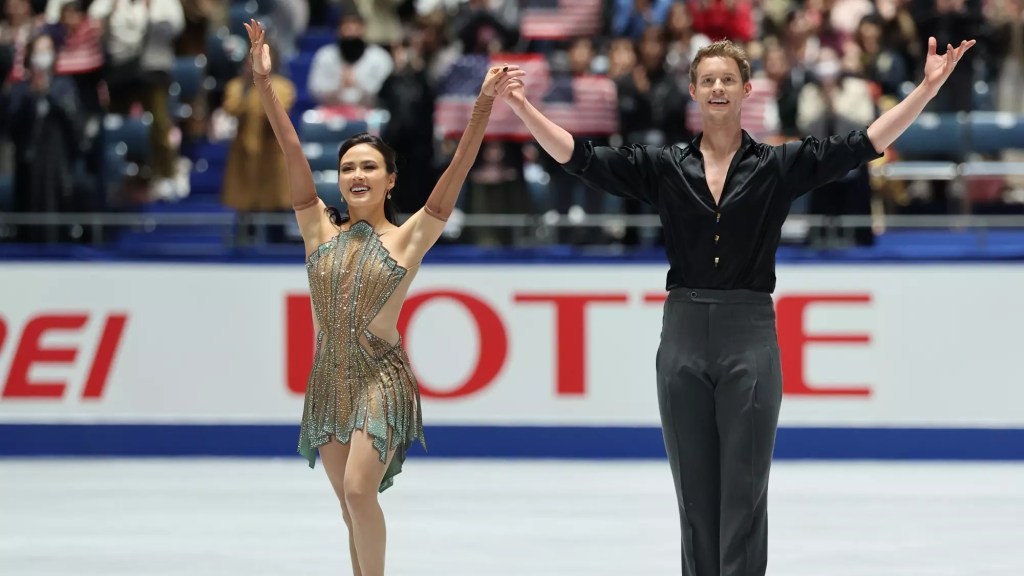
At its core, figure skating is an inherently subjective sport, frequently leading to scoring controversies and furious fans; as it is commonly said, on a different day with a different set of judges, the outcome of a competition may be different. But when it comes to the results of the Olympic ice dance event in Milan, the internet and the figure skating fanatics at large agree that American, three-time reigning World champions, Evan Chock and Madison Bates, were robbed of an individual gold medal.
For context, ice dance, introduced to the Winter Olympics in 1976, is a unique style in figure skating that is rooted in ballroom dancing; it emphasizes musicality, partnership, and dance technique. According to the Olympics’ official website, ice dance is the “only figure skating discipline in which no jumps are allowed (outside of single or assisted jumps).” Additionally, major lifts and throw jumps in which the male partner tosses his female counterpart into the air—seen in the pairs competition—are not permitted. Instead, the skaters receive points for their “twizzles,” which are much harder than their somewhat silly name suggests; twizzles are “traveling turn[s] performed on one foot with one or more continuous rotations.” The pairs must also complete lifts, spins, step sequences, and choreographic elements, each with its own degree of difficulty.
Each team first competes in the rhythm dance, which includes “pre-determined dance patterns performed to a specific rhythm of music within a required tempo range,” according to U.S. Figure Skating. Following the Olympic Rhythm Dance, gold-medal favorites Chock and Bates were virtually tied with their closest competitors, Laurence Fournier Beaudry and Guillaume Cizeron of France, with the Americans scoring 89.72 for their Lenny Kravitz-themed program, just 0.46 points out of first place. Seeing as the scores were quite similar to the team event, in which both pairs performed the same routines—though Chock and Bates finished in first—few had qualms with the results.
Although the same cannot be said for the free dance, which, “like the rhythm dance, features step sequences, lifts, and a broad selection of difficult skating skills, but the team skates to…music and tempo of their choosing.” Chock and Bates delivered an effortless rendition of their “Paint It Black” program, in which Chock portrays a matador and Bates a bull, earning a solid score of 134.67. Their performance was undoubtedly gold worthy, but, according to the judges, Fournier Beaudry and Cizeron were the better team, earning a 135.64 and finishing just 1.43 points ahead of the Americans. However, this result has been heavily criticized by skating fans—and deservedly so—as the French pair did not deliver a clean skate.
As stated by CBS, “In ice dancing, every element has a base value, or the number of points it’s normally worth; there’s also a grade of execution, for which teams are scored positively for doing well and negatively for doing poorly.” Cizeron had a major mistake at the very end of his twizzles, nearly falling out of them and losing synchronization with his partner, which is certainly something that the judges do not want to see. But seemingly, the judges did not notice this mistake, as the pair was not marked down for what should have been a blatantly obvious error. They also struggled on their rotational lift; Cizeron visibly slipped and almost lost his balance, but somehow, the lift still received 7.71 out of a maximum of 7.85 points.
Moreover, the pair’s routine, set to music from “The Whale,” was a bit boring, although it featured some masterful skating, and lacked some of the artistry found in Chock and Bates’ flamenco-inspired routine. Ignoring the fact that Fournier Beaudry and Cizeron are a controversial team—Fournier Beaudry has unwaveringly supported her ex-partner, who was suspended last year due to sexual assault allegations, and Cizeron was accused by his former parter, with whom he won gold at the 2022 Winter Olympics, of being abusive and threatening towards her—it is extremely confusing that their skate was a personal best, and that it bested the Americans.
That said, it is a bit clearer how the French edged out Chock and Bates when analyzing the scores from each individual judge. For the ice dance competition, there were nine judges, each from a different country, and to calculate the overall scores for routines, the highest and lowest scores for each element and component were dropped, with the rest being averaged out. The judge from France has deservedly faced backlash for their scoring in the free skate. They gave Fournier Beaudry and Cizeron a total score of 137.45—the second highest score the pair received—and Chock and Bates a mere 129.74 points, which is incredibly shocking, as a near-eight point differential in ice dance, where scoring is always so tight, is incredibly significant and highly illogical, considering that every other judge scored them about 131 points, with most judges awarding them at least 135. In fact, five out of the nine judges had the Americans in first place overall in the free skate. This substantial score discrepancy certainly contributed to Chock and Bates losing out on their individual gold medal.
Again, while the French gave a solid skate, their routine was not clean, and it was nowhere near eight points better than the Americans. Certainly, these results call the legitimacy of figure skating judges into question and show just how unpredictable subjective sports can be.
Nevertheless, what Chock and Bates did was impressive, and their individual silver medals cemented them further into ice dance history. After the competition, Chock said, “We have had the most incredible year—15 years on the ice together; first Olympics as a married couple. And we delivered four of our best performances this week. I think we’re really proud of how we handled ourselves here and what we accomplished.”
 Lyon Life