Nathan VanSteenkiste ‘26, Copy Editor
Last month, in my article, “Athletes are not animals,” I wrote that “the baiting of athletes for clickable content is the antithesis of true journalistic integrity” and that “athletes deserve better than being taken advantage of or manipulated by journalists when they are in emotional states.”
I specifically cited American Learner Tien, who was asked political questions directly after a disappointing loss at the Australian Open, and indicated how journalists will ask these types of questions, fishing for catchy headlines. I empathized with Tien, who was placed in an awkward position—either answer and potentially face backlash, or remain silent and be criticized for not using his voice. While Tien did not entertain the journalist’s leading questions, at the 2026 Winter Olympics, many athletes weighed in on the current state of our nation, and the former occurred.
American athletes—including freestyle skiers Hunter Hess and Chris Lillis, figure skater Amber Glenn, and others—who simply exercised their right of free speech were openly scrutinized by the Trump administration and the American general public for not being “patriotic” enough.
In a press conference, the aforementioned skiers were asked by reporters what it was like competing at the Olympics underneath the current administration. Lillis was not hesitant with his views, and said, “I think that as a country, we need to focus on respecting everybody’s rights and making sure that we’re treating our citizens as well as anybody. I hope that when people look at athletes competing in the Olympics, they realize that that’s the America that we’re trying to represent.” Hess echoed his comments, explaining, “just because I wear the flag, it doesn’t mean I represent everything that is going on in the U.S..”
Despite giving perfectly reasonable answers in which they simply indicated that they are morally conscious individuals—Lillis and Hess’ comments were not hostile, and although inferences can be made, they did not outrightly criticize any leaders—the pair faced backlash. President Trump dubbed Hess a “real loser,” whining in a social media post that if Hess was not going to be unapologetically “American” and fully support the actions of his country, “shouldn’t have tried out for the Team, and it’s too bad he’s on it.” Other right-wing politicians backed their president, with comments ranging from telling Hess to “go play in the snow,” to telling him he should move to Canada, according to CBS News.
Besides these statements being childish, what is ironic about this dispute is that there is seemingly nothing more “American” than exercising one’s right to free speech. I wonder: what makes Hess, Lillis, or any other American who condemns their country’s actions any less of a citizen because they have a differing opinion? Is that not one of the fundamental rights of our democracy? Also, what gives Trump—a man who has been impeached twice, is a convicted felon, has lost the support of many from his own party, and has been repeatedly linked to questionable individuals—the right to judge them?
In fact, Trump, not Hess, is the “loser” for trying to police how to be an American. Just like someone can dislike a song released by their favorite artist, or a Democrat disagrees with a law their party is trying to pass, Olympic skiers can disagree with how their country acts. Political leaders’ decisions to silence the opinions of others—including those of athletes—are an infringement on their constitutional rights and simply shameful.
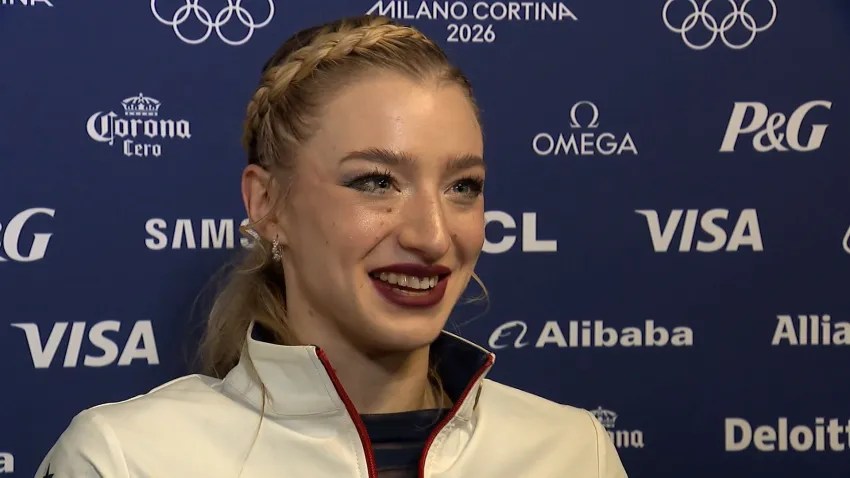
Additionally, look at how the internet reacted when figure skater Glenn, the first openly out LGBTQ+ woman to skate at the Olympics, spoke out against issues affecting the community prior to the Games: people ruthlessly bullied and targeted her, especially after Glenn made mistakes in the individual and team free skate.
After being asked by a journalist, Glenn said that “It’s been a hard time for the community overall [under] this administration…And now especially, [their actions are] not just affecting the queer community but many other communities.” She added, “I hope I can use my platform and my voice throughout these Games to try and encourage people to stay strong in these hard times. I know that a lot of people say you’re just an athlete, like stick to your job, shut up about politics. But politics affect us all.”
However, many online were not receptive to Glenn’s opinions, and simply told her to shut up about social causes and to focus on skating, which, of course, indicates they completely missed her point about athletes’ voices having value. Glenn posted to her Instagram Stories days after making the comments, “I am now receiving a scary amount of hate/threats for simply using my voice WHEN ASKED about how I feel. I did anticipate this, but I am disappointed by it.” Frankly, it is shameful how we, as a society, make such a big deal about athletes and celebrities needing to use their platform to speak up about crucial social issues, but then, when they do, people still find a reason to be upset and hold it against them. Just as Glenn had a right to compete at the Games, she had a right to speak her mind, especially considering that journalists asked her politically-charged questions in the first place.
It is also worth noting that Glenn, Hess, and Lillis were not the only three athletes to condemn the current administration and the ongoing social crimes in our nation. Legendary snowboarder Chloe Kim; American-born freestyle skier Eileen Gu, who competes for China in the Games; Alpine skier Mikaela Shiffrin; and curler Rich Ruohonen, among others, according to Britannica, all deserve praise for their bravery to advocate for change despite the potential extremely public ramifications.
In our current political climate, it can be extremely challenging to use one’s voice for “good.” While athletes are not responsible for doing the jobs of politicians, their voices do have an impact on people, including, and most importantly, when we see them representing our nation—flaws and all—at the Olympics.
 Lyon Life