Nathan VanSteenkiste ‘26, Copy Editor
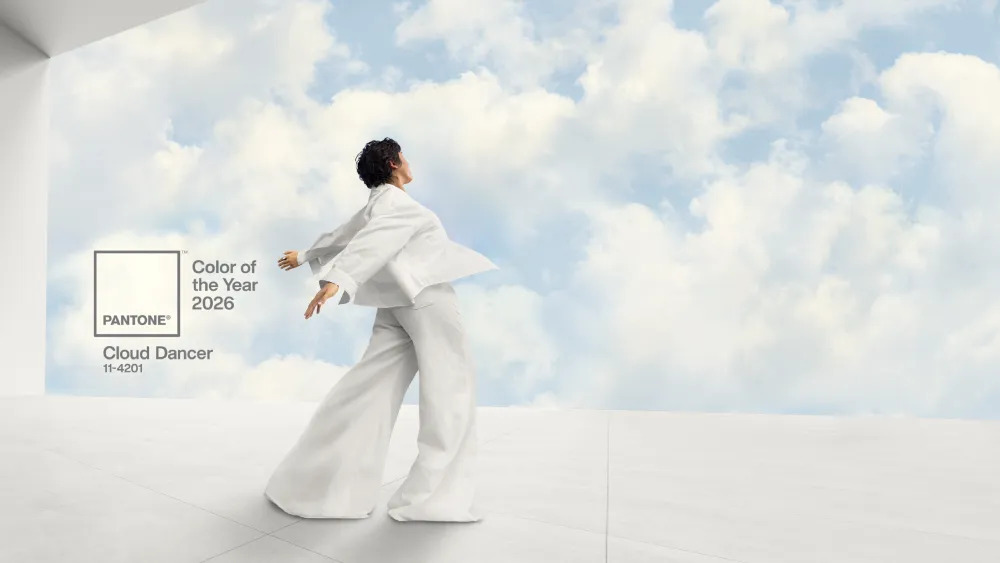
PANTONE 11-4201 Cloud Dancer, Pantone Color Institute’s 2026 Color of the Year, is not “similar to a blank canvas,” nor does it “[open] up space for creativity, so that new insights and bold ideas can emerge and take shape,” as Laurie Pressman, the Vice President of Pantone, suggests. In reality, it is a bland shade of white, symbolic of society’s sad beige era. Cloud Dancer predicts another year featuring uninspired neutral tones, a lack of innovation, and whitewashing. Unlike what Pantone’s color experts claim, it is not a calm, cozy, and clean hue—the washed-out white is lifeless and underwhelming.
Since 1999, Pantone, “a leading authority on color,” as described by CNN, “sift[s] through current cultural, political, and style references” to find the precise shade that will symbolize the trends of the forthcoming year. Most years, the chosen colors have vibrant personalities, such as 2007’s PANTONE 19-1557 Chili Pepper or PANTONE 17-5641 Emerald in 2013. But, in recent years, the institute has shifted in a more monochromatic direction. What began with PANTONE 13-1023 Peach Fuzz in 2024 and PANTONE 17-1230 Mocha Mousse in 2025, Cloud Dancer marks the third consecutive neutral tone to be selected, and it is by far the company’s most controversial choice.
Historically, most Western civilizations view white as a color that, according to Verywell Mind, represents “purity, cleanliness, and peacefulness,” and it is often worn at social gatherings that promote peace and unity, such as weddings. Opposingly, in many Eastern cultures, especially in Asian countries, “the color white is often symbolically linked to death and sadness,” and it is commonly seen at mourning ceremonies, including funerals. Evidently, Cloud Dancer likely has a drastically opposing significance for different groups of people.
In a way, Pantone is right in line with the Eastern way of thinking, as they are, in fact, mourning something with their selection of a white hue: the death of creativity, uniqueness, and originality. This societal change corresponds to the rise in artificial intelligence (AI). Since 2022, when OpenAI released its chatbot, ChatGPT, AI has had a meteoric rise in popularity; CNN writes, “The rise of AI Chatbots like ChatGPT and Google’s Gemini has gradually influenced online services used by millions every day, from Google search’s AI Mode to the AI chatbots built into Instagram and Amazon.” These sites, which are trained by the internet—stealing information from images, social media posts, and even newspaper articles—can repurpose this information, producing generic, formulaic responses aimed to please their users.
According to Business Insider, “As of September 2025, ChatGPT had accumulated nearly 800 million weekly active users.” That number has only increased. It feels as if no one can have an original, complex thought anymore that is independent of a chatbot—AI has infiltrated almost every avenue, and it is virtually unavoidable. Even art, literature, and music have been affected. Chatbots can generate jarringly realistic images, AI can reference existing works of fiction to write things like fanfiction, and songs, such as “I Run” by HAVEN, which features AI vocals, went viral in 2025. These examples highlight society’s increasing overreliance on AI, leading to a society, as Forbes puts it, “no longer shaped by independent thinkers across different cultures, but by predictive algorithms.” Pantone claims that Cloud Dancer is creating a ‘blank canvas’ to create something new, but how can one think of something, let alone make it, when uniqueness and original thought are being replaced and devalued by AI? How can a dreary color counteract the soul-sucking blandness of AI?
On social media, influencers seem to have adopted this trend of neutral tones too, with “sad beige moms” —parents who dress their children in bland shades instead of bright colors and decorate solely with muted hues—trending in early 2022. While the movement sounds ridiculous, it is just another way society is stifling expression. Color is dead. Instead, everything has to be black and white—or rather, beige. Visually, Cloud Dancer represents the loss of color in our world, but Pantone sees it as a declaration of ‘creativity’ and potential ‘bold ideas.’ Not only does the color they chose to represent hope and uniqueness miss the mark because it is inherently boring to look at, but Pantone’s selection of a white shade is politically tone-deaf, or as critics have called it, “Pantonedeaf.”
And this move is especially questionable after such a devastating and embarrassing year for human rights in the United States. President Donald Trump signed an executive order in January that cut funding for Diversity, Equity, and Inclusion (DEI) programs, leading to fewer opportunities for members of marginalized groups. Moreover, raids in major cities, led by the U.S. Immigration and Customs Enforcement (I.C.E), resulted in racial profiling, wrongful detentions, and multiple deportations of legal American citizens. According to The Guardian, “Immigrants with no criminal record…make up the largest group in US immigration detention,” indicating that individuals, especially those of color, are simply being arrested without probable cause; in total, I.C.E, following direct orders from Trump, made over 328,000 arrests and nearly 327,000 deportations from January to mid-December 2025.
Frankly, choosing a shade of white as the defining color of 2026 after such a challenging year for people in marginalized communities was illogical on Pantone’s part. While the company repeatedly defends itself by saying that skin color was not a factor in their decision, they must also recognize how their decision could be perceived as pushing a “white is right” agenda. In a review of Pantone’s decision, Vogue Magazine wrote that “white is a color that does not disturb, does not rock the boat, a color that is easily found in everything around us,” suggesting that white is an inherent part of everything and that it is something that is to be viewed as superior. And although it was likely not Pantone’s intention to spread the idea that white is something everyone must compare themselves to, the decision sets a dangerous precedent as the world enters the new year. What the world needs now is a fresh canvas, like Pantone suggested in their marketing, but one that allows for inclusivity, originality, and creativity—not one that indirectly suggests white superiority and mourns original thought.
 Lyon Life