Logan Skrzypek ‘27, Copy Editor
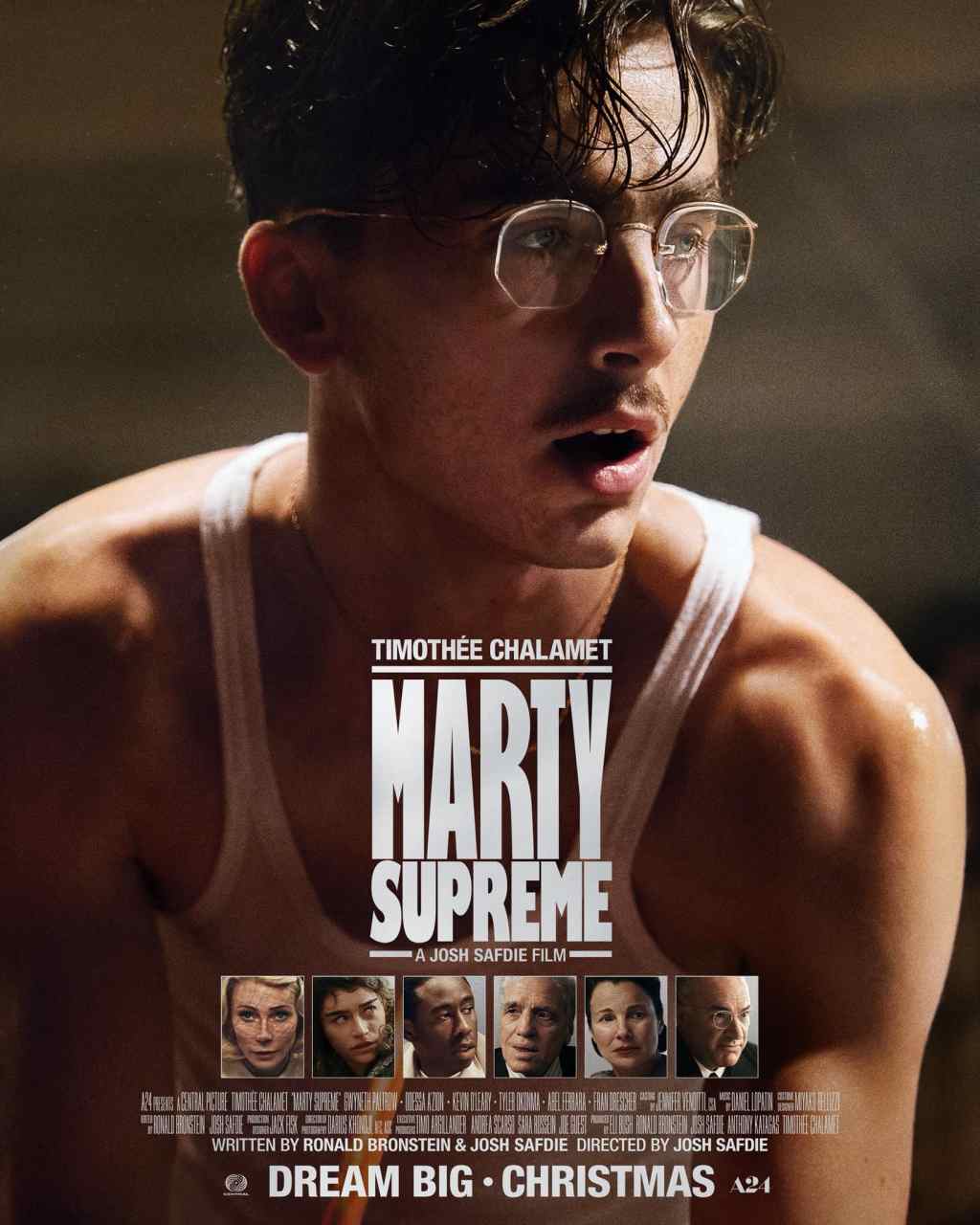
In a cinematic year filled with safe sequels and recycled IP, Marty Supreme crashes onto the scene at the last minute like a live wire. Directed by Josh Safdie and starring Timothée Chalamet, this ping-pong-fueled character study is anything but predictable. It is loud, relentless, and deeply personal—a film that does not just ask for attention, but grabs you by the collar and dares you to look away.
Released by A24 on Christmas Day, Marty Supreme has already made history. It pulled in $28.3 million over its first five days in wide release, the biggest opening for the indie studio. That came on the heels of a limited debut that earned $857,000 across just six theaters, with a staggering per-screen average of $145,900—the highest of 2025.
Set in a stylized version of 1950s New York, the film follows Marty Mauser, a fast-talking shoe salesman with a singular obsession: becoming the greatest ping-pong player alive. While the character is loosely inspired by the real-life table tennis legend Marty Reisman, Marty Mauser is a fictional creation—more fever dream than biography. What starts as a quirky sports story quickly morphs into something darker and increasingly chaotic. Marty’s journey takes him from backroom matches to the edge of self-destruction, all in pursuit of greatness that may or may not exist.
The director, Safdie, is not interested in a traditional underdog tale. Instead, he uses the sport as a lens to explore the cost of ambition, the hunger for validation, and the fine line between confidence and delusion. The film’s plot is deceptively simple, but the way it unfolds is the exact opposite. Safdie’s signature style—shaky handheld camerawork, rapid-fire editing, and a pounding score—turns even the smallest moments into pure high-stakes drama. Each ping-pong match becomes a war zone, each conversation feels like a ticking time bomb.
Chalamet has never played a character quite like this in his previous filmography. As Marty, he becomes a whirlwind of nervous energy and raw charisma, constantly teetering between brilliance and breakdown. It is a performance that is both exhausting and exhilarating. Brian Tallerico of RogerEbert.com wrote, “Safdie’s daring choices merge with the best performance of Chalamet’s career. It is a story of a man who thinks he is the best in the world at something, and that thinking is as important as actually being it.” He added, “Marty Mauser is anxiously stretched like a piano wire by his unrelenting ambition yet still so pleasantly malleable for life’s swift paddle to the rear end.” Chalamet’s portrayal is messy, vulnerable, and completely captivating. He does not just play Marty—he disappears into him.
Safdie surrounds Chalamet with a cast as unpredictable as the film itself. Gwyneth Paltrow returns to the screen as Kay Stone, a glamorous former actress and socialite who becomes romantically entangled with Marty. Odessa A’zion plays Rachel Mizler, Marty’s childhood friend and emotional anchor, offering a grounded counterpoint to his spiraling ambition. Kevin O’Leary—yes, “Mr. Wonderful” from Shark Tank—makes a surprisingly effective film debut as Milton Rockwell, a slick ping-pong promoter who sees dollar signs in Marty’s mania. Tyler, the Creator (credited as Tyler Okonma) brings chaotic charisma to Wally, Marty’s unpredictable rival on the underground circuit.
The film’s visuals and sound directions are just as intense as its lead. Cinematographer Darius Khondji gives the city a gritty, saturated glow, while Daniel Lopatin’s synth-heavy score pulses with tension. Needle drops from Public Image Ltd., Peter Gabriel, and Tears for Fears add a surreal edge that somehow fits perfectly. Safdie’s direction turns every scene into a pressure cooker. The ping-pong matches are shot like action sequences, with sweat flying, paddles cracking, and the camera whipping around like it is trying to keep up with Marty’s mind.
In terms of awards given to the film, the 2026 Critics’ Choice Awards on Jan. 4 nominated Chalamet for Best Actor and the 2026 Golden Globe Awards on Jan. 11 for Best Actor in a Musical or Comedy Film, and he won both awards among other actors including Michael B. Jordan and Leonardo DiCaprio. He gave affirmation towards Safdie at the Critics’ Choice Awards for his production of the film and said, “…you made a story about a flawed man with a relatable dream. You did not preach to the audience about what is right and wrong, and I think we should be telling stories like that. So thank you for this dream.”
At its heart, Marty Supreme is not about ping-pong entirely, it is about the American obsession with being the best—at anything, at everything. Marty is not chasing a trophy, he is chasing a sense of purpose, a reason to matter. In doing so, he burns through relationships, sanity, and maybe even himself. Safdie does not offer easy answers, he just drops the audience into Marty’s world and lets us feel the heat. The result is a film that is as thrilling as it is uncomfortable, as funny as it is tragic.
In a year full of noise, Marty Supreme cuts through with something rare: urgency. It is not just a movie—its a full-body experience, a roller coaster. And it might just be the most unforgettable ride of the year.
 Lyon Life