Nathan VanSteenkiste ‘26, Copy Editor & Madelyn Furstenau ‘26, Editor-in-Chief
SPOILERS LIE AHEAD
Nathan’s Overall Review:
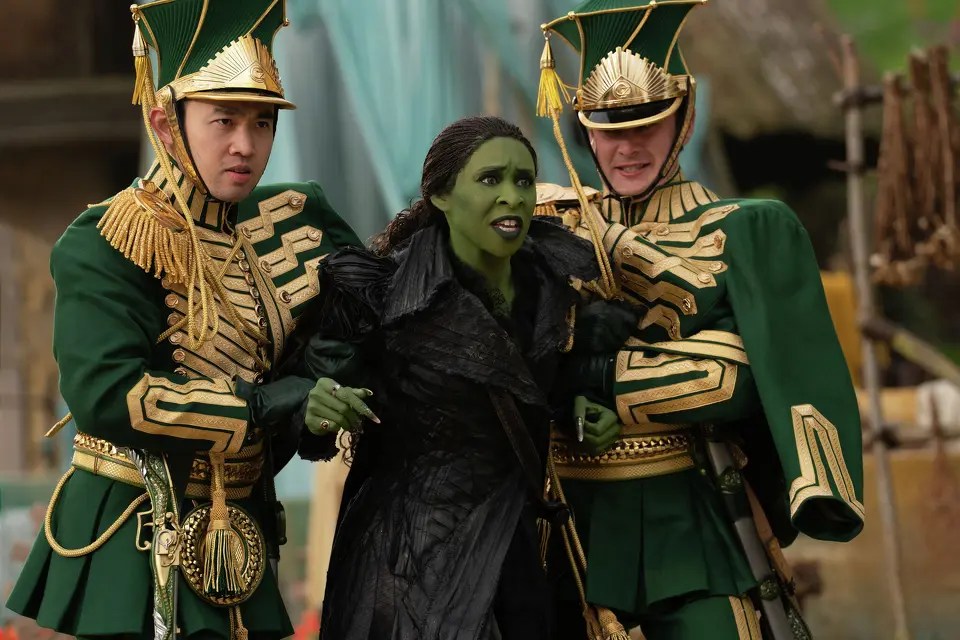
Wicked: For Good is a thrillifying triumph that not only effectively brings the second act of the Broadway musical to life but also cleverly expands upon a conclusion that has long faced criticism for having several plot holes and confusing resolutions. Led by unforgettable performances from Cynthia Erivo as Elphaba, the proclaimed ‘Wicked Witch of the West,’ and Ariana Grande as ‘Glinda the Good,’ director Jon M. Chu’s film is a tragic, emotional, and vivid depiction of the tribulations of friendship, while simultaneously serving as a warning against political propaganda and a commentary on society’s inherent nature to forgo critical thinking in an authoritarian-like regime.
While the second film has a much starker tone throughout, causing many people, especially critics, to find it significantly less appealing to watch—Wicked: Part One debuted with a 92 percent score from critics on Rotten Tomatoes versus Wicked: For Good’s 70 percent—it contains some of the best scenes from either film. The entire “No Good Deed” sequence, in which Elphaba finally accepts the ‘Wicked’ title society has bestowed upon her, vowing, “No good deed will I attempt to do again,” is cinematographically brilliant. The scene’s vivid, fiery-orange color grading, Erivo’s chilling vocals, and the constant swirling dust and ash perfectly symbolize Elphaba’s epiphany that she has no choice but to play her part as Oz’s villain. Unlike what Joonatan Itkonen, a critic for Region Free, said, calling this part of the film “downright pointless because it comes and goes so quickly it barely registers,” this scene is the most captivating from either film, is crucial to the plot, and is not meant to be a lengthy declaration. Instead, it is a moment of panic, with Elphaba plotting on how to proceed in the absence of Prince Fiyero (Jonathan Bailey), and following Glinda’s betrayal.
That said, there were some blatant issues with the construction of the film—not with the pacing itself, as many critics like Itkonen are quick to blame—most of which stem from flaws with the stage musical itself. Historically, Wicked’s second half has been labeled by many as confusing and disorienting, as it tries to weave the plot of The Wizard of Oz into the ongoing conflict between The Wizard—played by Jeff Goldblum—and Elphaba. Dorothy, portrayed by Bethany Weaver, is introduced following the death of Elphaba’s sister Nessarose, who is played by Marissa Bode, when a house falls on top of her—an intentional murder by The Wizard and Madame Morrible, acted by Michelle Yeoh, to lure Elphaba from hiding. Glinda, who greets Dorothy, gives away Nessarose’s silver shoes and sends the young girl off on the yellow brick road. This decision infuriates Elphaba, as the shoes were the only thing she had left of her sister. For the rest of the film, the two are at odds, with Dorothy eventually “killing” Elphaba (she does not actually die).
At times, it is very fascinating to see how Dorothy’s actions coincide with the characters from Wicked: Part One—how Boq, played by Ethan Slater, becomes the Tin Man; the lion cub from the first film is now the Cowardly Lion, voiced by Coleman Domingo; and how Fiyero transforms into the scarecrow, which is revealed to the audience at the very end of the film—but the timelines are exceptionally confusing. How is it possible for the group to walk to the Emerald City, find Elphaba, and “kill” her within what is portrayed as a span of minutes? How does Dorothy not see Elphaba escape through the trap door? What is Dorothy doing while Glinda and Elphaba belt “For Good”? To answer these questions, one has to suspend their belief in what is real—something required in almost all musicals—which is not Chu or any of the actors’ faults. They all do a great job of clarifying a challenging plot point in a way that respects the original while also making sense for the film.
One of the other main flaws of the second film is that it did a poor job establishing the chemistry between Elphaba and Fiyero—which neither Erivo nor Bailey is to blame for. In “As Long As You’re Mine,” the lustful ballad the pair sings together, the two characters barely interact, let alone in a romantic fashion. At the beginning of the song, when Erivo says, “Kiss me too fiercely, hold me too tight,” they are on opposite sides of Elphaba’s treehouse rather than embracing each other. Though the scene itself is stunning and Erivo and Bailey have fantastic vocals throughout the song, the staging left more to be desired. Although the film is rated PG, and some viewers, especially parents, feel that the scene was already overstepping what is considered “appropriate,” more tension, at the very least, would have benefited the film. According to Capital.FM, countries in the Middle East have even altered the scene, removing the one kiss Elphaba and Fiyero share and editing a shirt onto Bailey.
Ultimately, Wicked: For Good is a brilliant film with moments that outshine its more popular predecessor, but also flaws that cannot be entirely overlooked. Although critics are more than entitled to their opinions, it does feel like the feedback the film has received is both unfair and unwarranted. The sets and costuming are amazing. The acting, especially the range shown by Grande, is stellar. For the most part, the vocals are pristine. And though it has a darker tone, the film is wickedly entertaining. So, before jumping to criticism, one must ask oneself: Do you actually dislike Wicked: For Good, or just musicals at their core?
Mady’s Overall Review:
Although in the early stages of its release, it is safe to say that Wicked: For Good will go down as one of, if not the biggest, cinematic masterpieces of the year. In its first 48 hours, the film made back 133 percent of its extensive $165 million budget, selling out theaters all over the world. Within its opening weekend, Wicked: For Good made over $226 million in box office profits, establishing itself as the biggest Broadway adaptation of all time, surpassing the record set by its 2024 predecessor, Wicked. Chu’s remarkable work created a magical experience that has absolutely shaken the Wicked fanbase and has also drawn in millions of viewers who were previously unfamiliar with the Broadway show. The franchise has grown exponentially in the last year, and now that the second film is finally ours, critics have much to say about Wicked.
Now that both films are out, fans have been quick to compare the two, debating which is ultimately the best. For a fair comparison, it comes down to soundtracks, acting quality, and important overall scenes. While Wicked arguably takes the cake for best soundtrack with fan favorites such as Erivo’s vocally stunning take on “The Wizard and I,” Grande’s widely-adored rendition of “Popular,” and, of course, the ever-iconic “Defying Gravity,” Wicked: For Good has two of the best songs in the entire musical: “No Good Deed” and “For Good.” Even though the second film falls a bit short in fans’ liking from a musical standpoint, it certainly does not lack meaningful, emotional scenes and breathtaking acting from the entire cast. While Wicked has its share of tear-jerking moments, Wicked: For Good is sure to break you apart and then put you back together, only to shatter you once more. The cast of Wicked beautifully portrays the dangers of discrimination, believing in propaganda, and building a persona based on deception and artificiality. While Elphaba takes on the daunting task of protecting the animals of Oz from being hidden in the shadows, forbidden to speak, Glinda struggles between doing what is right and maintaining her perfectly curated image. This carries into the second film, where Elphaba is shunned from society, wrongfully painted as the ‘Wicked Witch of the West,’ all while Glinda becomes a public figure responsible for promoting goodness in times of baseless fear and uncertainty. These crucial moments of realization and purpose make it impossible to choose which film is fundamentally better, as you cannot fully understand the story of Wicked without key moments from both works.
Amongst a vast sea of praise, compliments, and adoration for this beautiful franchise, one striking criticism seems to arise time and time again: it seems as though three major female characters in the Wicked cast have lost a concerning amount of weight. Ariana Grande, Cynthia Erivo, and Michelle Yeoh, who star as Glinda, Elphaba, and Madame Morrible, appear to be in extremely unhealthy physical states, which has caused an uproar on social media. While many defend these women, saying that it is nobody’s place to comment on another’s body, others are genuinely concerned for these actresses, as their emaciated figures indicate declining physical health. In the film, there are several scenes in which Grande’s outfits expose the outlines of her skeleton, which has caused overwhelming discourse online. Some have blamed Grande for indirectly promoting unhealthy beauty standards, as Wicked is catered to a younger audience. These young, impressionable viewers may internalize an accentuated sternum and collarbone as the norm, which can be extremely detrimental to not just their physical health, but mental health. While Erivo and Yeoh’s attire in the movie did not give the same alarming effect as Grande’s, recent red carpet and award show appearances have made it clear that the two actresses are also in dangerous conditions following the production of both Wicked films. All of this has led to speculation regarding the treatment of the actors and actresses on set, and whether or not we should be seriously concerned for these women and their well-being.
Another criticism that has been circulating since Wicked: Part One made its debut last November is that Grande and Erivo are much too emotional in their interviews regarding the movie. In most of these interactions, the two are almost guaranteed to shed a tear, especially when recalling the filming process or a particular theme of the film. Although on the surface, their display of emotion can seem a bit excessive, the reasoning behind their frequent teary-eyed appearances makes perfect sense upon watching the film. Wicked is an emotionally rich and beautiful story of two young women on opposite sides of the social spectrum who overcome their differences and form a soul-binding friendship that genuinely changes them for the better. Much like Elphaba and Glinda, Erivo and Grande themselves grew exceptionally close during the production of both films, and in the process, truly healed something in each other. They have certainly faced hardship in their lives, and these roles and their authentic connection with one another noticeably softened the two actresses. Playing such a significant part of this incredible story and experience was understandably life-changing, and those who are quick to scoff at their rather public vulnerability have likely never actually seen Wicked. After all, the famous “door scene” at the end of Wicked: For Good is hands down the most heart-wrenching of either movie—and it was improv. The delicate display of heartbroken emotion that Elphaba and Glinda share in this scene was really that of Erivo and Grande, and it brought the sheer power of Wicked’s story to new heights. Rather than judging the two for being “too sensitive,” we should recognize that their affection for this film is an endearing superpower.
Soundtrack Ranking:
- No Good Deed
- For Good
- The Wizard and I
- Defying Gravity
- What is this feeling?
- Im not that girl
- As long as you’re mine
- No place like home
- Dancing through life
- Girl in the bubble
- Popular
- Thank Goodness / I Couldn’t Be Happier
- No One Mourns the Wicked
- Wonderful
- Every Day More Wicked
- I’m Not That Girl (Reprise)
- One Short Day
- March of the Witch Hunters
- The Wicked Witch of the East
- A Sentimental Man
- Something Bad
- Dear Old Shiz
Ranking an album as extensive, sonically diverse, vocally unparalleled, and thematically broad as the soundtrack from the Wicked movies is virtually impossible. From upbeat bops with exceptional replay value, like “What Is This Feeling?”, to the emotionally-charged ballad “For Good,” there is at least one song for everyone.
“The Girl In The Bubble,” an original song for the second film, was one of the best additions Chu made to the franchise. Beyond offering incredible vocals from Grande, the song’s lyrics effectively showcase Glinda’s realization that to be truly good, she must shed the facade she has been maintaining her entire life. She is privileged. She lies. And she unfairly judges Elphaba throughout the film. But this song shows that although her character is flawed, there really is a part inside her that is good.
The highest-ranking song from Wicked: Part One, “The Wizard and I,” is an underrated track in comparison to the extremely popular “Defying Gravity.” Although Erivo brings a fierceness to the concluding track of the first film, one cannot overlook the vocal talent she showcases in “The Wizard and I.” It is such an interesting song to compare to the second half of the musical, as Elphaba’s dreams do come true, but not at all how she imagined: a celebration is held throughout Oz because of her, but not for doing good; instead, it is because she is presumed dead.
The Political Undertones of “No Place Like Home”
“No Place Like Home” is another original and stands out for its refreshing, relevant political commentary. The song is performed by Erivo at the beginning of Wicked: For Good. She sings to a group of animals fleeing Oz in response to new laws that strip them of their freedom; the Wizard orders that all animals be put in cages so that they will lose their ability to speak, as their intelligence poses a threat to his dictatorial rule.
In the first verse, Elphaba says, “Why do I love this place that’s never loved me? A place that seems to be devolving. And even wanting to? But Oz is more than just a place. It’s a promise, an idea. And I want to help make it come true.” Through these lyrics, she emphasizes with the animals and their feelings of disdain towards Oz, but she also expresses how important it is to her—and how she does not want to give up her pursuit of trying to make it “good.” Although it is only “land, made of dirt and rock and loam,” Oz is her home, and there is no place like it.
This directly correlates with the emotions many Americans currently have—those of minorities, like the LGBTQ+ community, women, and people of color—as many love their country, calling it their home, but cannot bear to live in a place that does not love them in return, even struggling to accept their existence.
Composer of Wicked, Stephen Schwartz, said of the political undertones of the song, “Whether you like it better or you don’t like it as well, there’s no denying that our country is changing around us, and we are not the only nation on Earth that that’s happening to. And so the question is, if it’s not the direction you want your country to go in, what do you do? Do you actually try to resist, which is dangerous and has very little chance of success? Or do you just give up?”
In addition to being a beautiful, tragic, and inspirational ballad, “No Place Like Home” highlights some of the main themes of the musical: resisting Authoritarianism and other oppressive systems, the concept of belonging, political division, racism, social justice, and inclusivity.
 Lyon Life