Lilah Birdyshaw ‘26, News Editor
Since its debut on Aug. 30 at the Venice Film Festival and Netflix release, Frankenstein—written and directed by Guillermo del Toro—has stunned audiences as an engaging and intense film. It is a brilliant adaptation of Mary Shelley’s 1818 novel, which is also referred to as The Modern Prometheus. Although filmed in about nine months, the movie was decades in the making, having been del Toro’s dream project since his childhood. Those years of passion are conveyed in the attention to detail, execution, and overall energy of the film. This is heavily reflected by its scores of 86 and 94 percent on the Rotten Tomatoes’ Tomatometer and Popcornmeter.
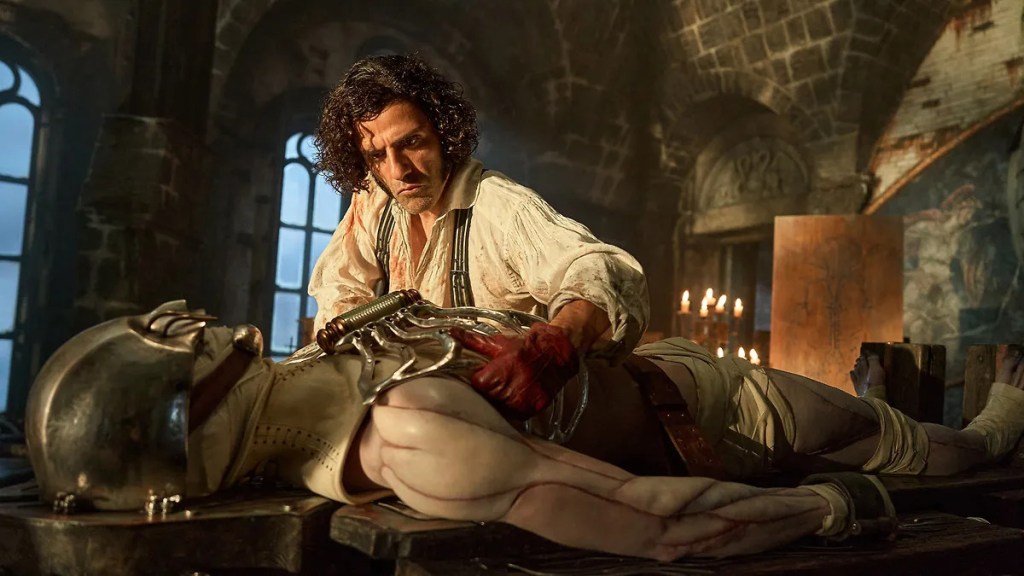
Jacob Elordi, who starred in hits like The Kissing Booth, Saltburn, and Euphoria, plays the creature, with Oscar Isaac as his maker, Victor Frankenstein. Although some of the novel’s characters are missing from the movie, such as Victor’s friend Henry Clerval and servant Justine Moritz, del Toro’s film more than makes up for it, delving deeper into Victor’s background while also taking on a new approach to the character Elizabeth Lavenza, portrayed by actress Mia Goth.
The original 1818 publication is a gothic tragedy—also considered to be one of the first science-fiction novels ever written—centered around a scientific genius, Victor, whose creation lives a tormented existence. Del Toro, while not looking to create a perfect copy of the novel, preserves the heart of Shelley’s life and works through what del Toro claimed was an “amalgam of [Shelley’s] biography, my biography, the Romantic movement, the novel, et cetera, et cetera.” Many fans agree that del Toro’s film is laced with similar emotions and themes to Shelley’s original novel, depicted through a nuanced perspective.
Even without considering the adaptation’s roots, it stands alone as a beautiful piece of media. Every detail—from the historic scenery to intricate costumes and stunning prosthetics—is purposeful, enabling viewers to engage with the film on a deeper level.
However, while each aspect of the film is outstanding, the dialogue stands alone as the most impressive feature. Del Toro manages to send viewers into the past while making it feel like the present—just with the dialogue. The monologues and the conversations between characters carry weight and strike a chord in every literature-lover’s heart, without feeling archaic. Many of Shelley’s iconic quotes are somewhat preserved in the film through impact, but they take on different vocabulary. For example, the line from Shelley’s novel that reads, “If I cannot inspire love, I will cause fear!” was changed to “If you are not to award me love, then I will indulge in rage. And mine is infinite.” Many film-lovers believe del Toro’s quote was also a reference to Kenneth Branagh’s 1994 film adaptation, in which the creature says, “I have love in me the likes of which you can scarcely imagine and rage the likes of which you would not believe.” Del Toro’s combination of popular lines from Shelley’s novel and other film adaptations exemplifies del Toro’s commitment to portraying the entire world of Frankenstein, rather than focusing on the novel independently.
According to Brittany Smithkort, Film as Literature teacher at SLHS, “This [film] did not disappoint…In my opinion, del Toro took on a big task, and he executed it well.” In all, del Toro’s 2025 hit Frankenstein is a beautiful film that engrosses and entertains viewers, and it is worth watching.
 Lyon Life