Luke Rector ‘28, Photo Editor
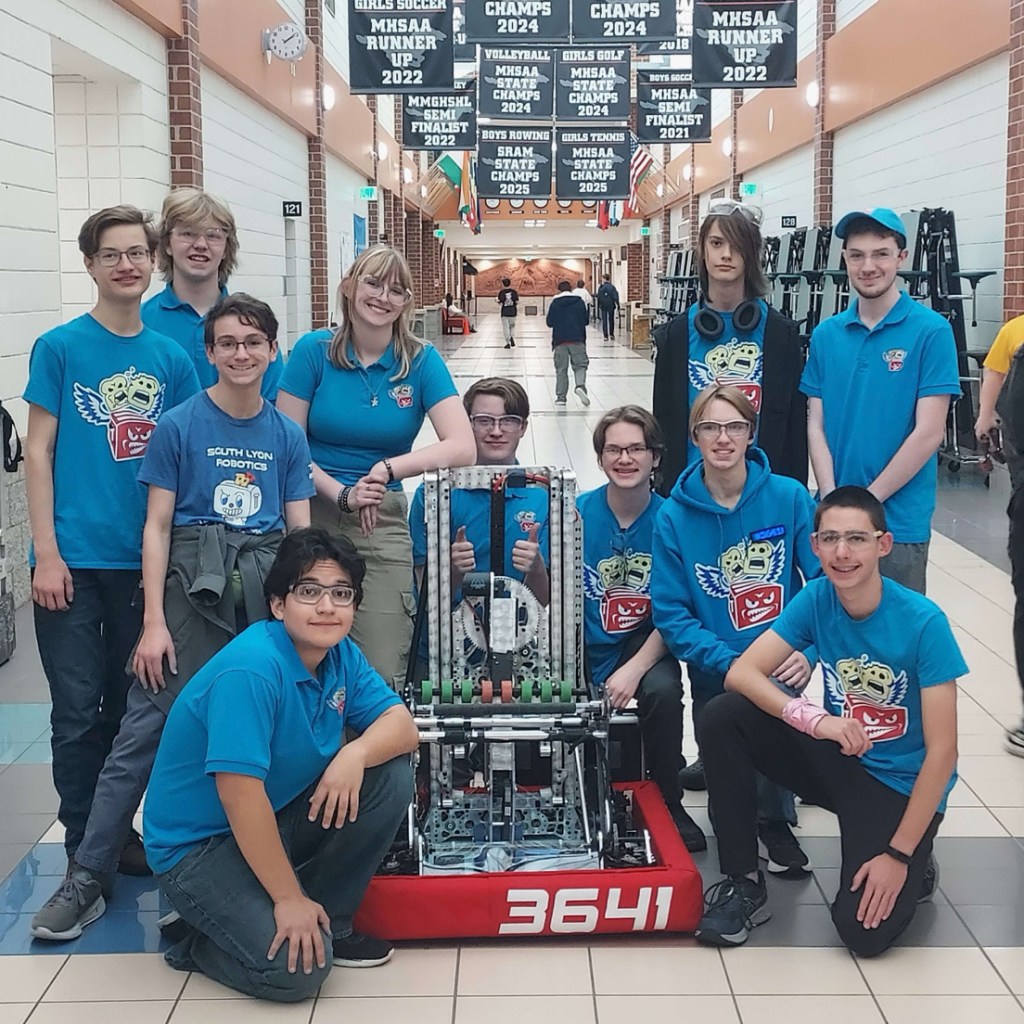
South Lyon High School (SLHS) and South Lyon East High School (SLEHS) have arguably one of the best robotics teams in the area due to their impressive catalog of victories and strong team bond. The team has been in service for 19 years and has spent 15 years as part of the FIRST Robotics Competition (FRC.). Their number is 3641 and goes by the name The Flying Toasters (TFT).
TFT builds and programs robots based on the challenges and games provided by the FRC. They then are put into various contests where they can score points along with their “alliances.” Alliances are a group of three teams where they all score points together and compete against each other. The groups of three are shifted for different teams per game.
TFT has won multiple awards over their 19 years, including the Industrial Design Award in Belleville and the District Engineering Inspiration in Livonia, both in 2025. They also won the Livonia District in 2013, the Lincoln District in 2018, and the Detroit District in 2019. TFT has a very impressive record when it comes to victories within various leagues and years. Overall the team has won a total of 36 different awards in their history as a program.
TFT themselves are divided into six main subgroups: programming, mechanical, strategy, electrical, machining, and outreach. Programming codes the robots to have them function properly; mechanical physically constructs and designs them; strategy comes up with ways to win games such as this year’s game, “reefscape”; machining makes the basic parts; electrical installs wires, and outreach is in charge of publicity and updating newsletters. Without each group, TFT would not nearly be able to function as thoroughly.
A typical meet involves giving the presentations on member’s sub-groups and working on various tasks like construction, improvements, vision, and teaching, that all need to be done on a given day. Meets start by going into a computer room, and members are given information on upcoming events and projects. After that is finished members break into their sub-groups to work on the robot in the workshop and advertise in the computer room. After a couple hours of this, the team goes home around 9 p.m.
The team is funded through various sponsors including Apple, the Michigan Department of Education, South Lyon Community Schools, and many more. The funds go towards parts, food, and reservations for the team. The robot’s parts cost 25,000 dollars alone, and this is not accounting for repairs and upgrades. The time and effort members put into designing and building it, which can take weeks or even months is also impressive.
Participating in robotics has been a beneficial experience for many members of the team; the members learn valuable skills in design, coding, construction and more. The team itself has a family-like bond, and members interact outside of robotics. The team and meets have a generally laid back environment. Sophomore Levi Manicke said, “I’ve [met] a lot of people, like half my friends are probably from this.” The team has a dedicated Discord for members to allow them to stay in touch outside of meets.
Despite being in the offseason, TFT is still busy in small scale competitions, within the past month TFT has conducted various activities and has gone to the Cullens Cancer Clash in Northville. TFT got to the twelfth match in the semi-finals within the losers bracket; the team did exceptionally well in almost all categories. They had a new team in charge of controlling the robot which has done a great job within their difficult time limit to learn. One particular game TFT did well in was the game titled “reef-scape”; an activity in which the team scores points by using the robot to put coral (plastic tubes,) into coral reefs (larger tube structures,) along with various other mini-games including having the robot climb and removing yoga balls from the coral reefs.
The robot was designed to score coral specifically much quicker than the opposing team’s robots over the other two mini-games, the main strategy was to be good at one specific thing rather than trying to be good at everything like other previous robots. This unique strategy is how the team primarily scored points for themselves during the match.
The founder of the FRC, Dean Kaman has a quote that rings home for TFT, he said, “We’re not using kids to build robots- we’re using robots to build kids.” If you are interested in joining TFT, email Mr. Ronald Weber at SLEHS. The team typically meets on Tuesdays and Fridays at SLHES between six and nine on Tuesdays and three to nine on Fridays.
 Lyon Life