Nathan VanSteenkiste ‘26, Copy Editor
Typically, following the championship round for any sport, one group of fans will be left disappointed by the outcome, while the other side is jubilant and celebrates. However, NASCAR’s recent championship weekend at Phoenix Raceway, from Oct. 31 to Nov. 2, left almost all fans disappointed—predominantly united in their displeasure with the current playoff format. Labeling it as unfair, gimmicky, and too dramatized for television, this recent championship was an embarrassing display, and it was the final nail in the coffin for the current iteration of the “playoffs.”
In the NASCAR Cup Series, a late on-track accident reshuffled the field, snatching the title from a veteran driver just three laps away from winning his first championship; in the NASCAR Craftsman Truck Series, a driver with 12 wins on the year almost lost the title after a late caution and pit stop, requiring him to make a daring dive underneath six other cars to regain track position. But most egregiously, in the NASCAR Xfinity Series, the driver most deserving of the title—the one who has dominated the entire season—lost the title to a driver with a mere one win. All three series finales were filled with theatrics, but they also highlighted the dangers of a winner-take-all race and how it can overlook a driver’s consistency throughout the season.
The current playoff system works as follows: a certain number of drivers qualify for the playoffs (16 for the Cup Series, 12 for the Xfinity Series, and 10 for the Truck Series), and there are three rounds, each consisting of three races. After the third race of a round, the four drivers with the fewest points, which are primarily attained by finishing position per race and through “playoff points,” which drivers accumulate throughout the season, are eliminated. And if a driver wins a race during a round, they are automatically guaranteed to progress. This continues until there are only four drivers left in each series; then, a championship “tie-break” race determines the overall champion. Similar to the final scene in Cars, the final four drivers battle—no other statistics from earlier in the season matter, so everyone is on an even playing field. Whoever finishes highest wins the title. The goal of the playoffs is to keep viewers invested and to make a profit rather than maintain the integrity of racing—NASCAR does not want the champion to already be decided with races left in the season.
For instance, in Formula 1 in 2024, Max Verstappen had already clinched the title, making the final two races entirely pointless. So, their solution is to constantly reset the points so that everyone is on an even playing field, forcing drivers to always be at their best—something that is incredibly difficult in motorsports, where dozens of things can go wrong that are entirely out of one’s control. While NASCAR’s playoff format may seem highly entertaining to the casual viewer, as all of the drivers are constantly scrambling to record every point possible, making for spectacular racing, it can also lead to results that do not feel “earned” or exactly right. This year’s Xfinity Series playoffs proved that.
After 19-year-old rookie Connor Zilisch lost the Xfinity Series Championship to his close friend Jesse Love, social media was heated with NASCAR fans expressing their outrage that Zilisch had the championship “stolen” from him. Zilisch had a historic 2025 season, recording 10 victories despite missing a race with a broken collarbone, the most wins for a rookie in the series’ history, and earned the title of Regular Season Champion, had 18 consecutive top five finishes, setting yet another record, winning eight poles, as well as earning 11 stage wins. Yet, he did not win the championship. Instead, it was Love, who entered the final race with only one win, which came in the series’ first weekend at Daytona International Speedway, just eight top fives, half as many poles as Zilisch, and only two stage wins. Nevertheless, he was crowned champion solely because he performed the best in the championship race.
As said by NASCAR journalist Eric Estepp on his show Out of the Groove, “You cannot make a serious claim tonight that [Love] was the most championship-deserving driver when you look at their body of work of the course of the season.” And he is entirely correct. Love was quietly consistent all season, running just “well enough,” but never quite putting up the results one would expect from a typical champion. Although he had a fantastic performance in the championship race, as his team worked on his car all night, making the correct adjustments that ultimately paid off in the race’s final stretch, Love was nowhere near as dominant throughout the rest of the season. He was deserving of the race win at Phoenix, but not necessarily the series championship. Meanwhile, Zilisch was penalized for having a subpar drive. In a press conference directly after the race, Zilisch showed exceptional maturity in his comments: “We have nothing to hang our heads about…We dominated until these last three races…We won the most races, had the most top 10s, top fives, [and] poles. There’s no reason we should be upset because of this outcome.”
While the 19-year-old is fair in his comments and offers a nuanced perspective, how can NASCAR knowingly keep the same format when it entirely ignores a driver’s past successes? The series is unforgiving to some, like Zilisch, but rewarding to others, such as Love. Some years, the format helps a driver, while other years it hurts them. 2024 Xfinity Series Champion Justin Allgaier explored this concept in a post race interview: “[Zilisch] had the best season but the format is the format, and they race this format…I don’t dislike the format. It’s bit me way more than it’s ever helped me, but last year when it helped us, it was great.”
Seemingly, the Craftsman Truck Series Championship was going to have a similar result with the most deserving driver, Corey Heim—who has won 12 of the series’ 25 races, recorded 19 top fives, seven poles, and 23 stage wins—being upset in the late stages of the race. But Heim was able to avoid the same fate as Zilisch. Despite taking four new tires after a caution with two laps to go, which shuffled Heim from the lead to outside of the top 10, he made a daring seven-wide pass, diving to the very bottom of the track, that got him back into contention—ultimately resulting in a race win and a championship.
While it is fantastic that Heim won, it is entirely unnecessary for a driver to have to make a SportsCenter-worthy pass to earn their rightful title. Heim won nearly half of the races on the series’ schedule, yet he almost lost the championship to another driver, one who did not win a single race all year, due to a late-race wreck that no one could have predicted. Crowning absolutely anyone else the champion would have been asinine and made the sport look foolish—as it did when Love won in the Xfinity Series. Estepp agrees and said, “When the parody is what NASCAR wants it to be, this format can work to some extent, but when you have dominant seasons, like [Heim] in the Trucks or [Zilisch] in Xfinity, the pitfalls of this format are exposed on the biggest and brightest stage.” By resetting the points in the final race of the year, NASCAR completely erases a season of successes, promoting drama and chaos instead. While sometimes the most deserving champion still prevails, like with Heim, the opposite also occurs—Zilisch is proof of that.
From NASCAR’s perspective, when the four drivers in the finale are closely matched, the deciding race is often exciting, and all of the drivers seem deserving of the win. And that was actually the case in this year’s finale for the Cup Series. All four of the drivers had at least three wins—Kyle Larson (three), Denny Hamlin (six), Chase Briscoe (three), and William Byron (three)—and they were always near the top of the regular season point standings. At Phoenix, Hamlin was the dominant driver all evening, leading 208 of the races’ 319 laps, and it looked like he was going to win his first championship in the Cup Series. This was especially exciting because Hamlin holds the record for most wins without a title (60) in series history.
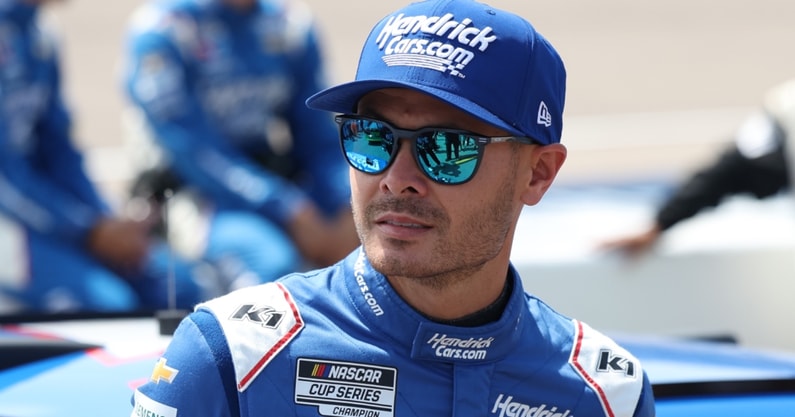
Just three laps away, the title was in reach for Hamlin and the rest of his crew, but suddenly, championship contender Byron blew a tire, causing a caution and forcing a two-lap shoot-out. Just like Heim the previous night, Hamlin’s team took a gamble, and he took four tires. But the loss of track position created a gap between Hamlin and Larson, the new leader in the championship standings, that was too vast for Hamlin to overcome. And so, Larson, without even leading a single lap in the Phoenix finale, became the 2025 NASCAR Cup Series Champion.
While Larson is undoubtedly a deserving winner of the title—especially because he scored more points than any other driver this season—the aura surrounding his achievement was subdued, with many fans not yet recovering from the whiplash that was the final caution. With three to go, NASCAR was already pushing the narrative that Hamlin had finally broken the curse, and the broadcast kept referencing Hamlin’s terminally ill father, Dennis, and how this year was his last chance to see his son win the coveted trophy. They thrust this narrative upon viewers, yet, somewhat ironically, the final result undermined all of this, making NASCAR’s theatre act seem forced and awkward. Hamlin’s loss was exceptionally heartbreaking, and it highlights that in racing, an unpredictable sport, a one-race championship may not be the best way to determine a champion.
So what can be done to fix a format that has caused so many chaotic moments and manufactured drama for years—how do you make the system more rewarding to “dominant” drivers? The easiest and simplest change would be to extend the championship race into a full round of three races, leaving every other aspect of the playoffs the exact same. While this would not make a big difference, it certainly would reduce the amount of “upsets” in the last round, as it would force the championship drivers to be consistent in an entire round of racing—something that is more balanced than a single race, winner-takes-all finale. Before the playoffs this year, NASCAR already began teasing that amendments would be made to the format before next season. Although it remains to be seen which aspects will be altered and “modernized,” fans will soon know how the drivers must adapt. Whatever NASCAR decides, hopefully, the “new” system is fair and leads to great racing that is not impacted by sensationalist storylines. Make racing the focus, and do not discriminate against successful drivers—that only leads to a lack of superstars and recognizable, accomplished names in the sport, thus limiting the sport’s growth.
 Lyon Life