Anderson Cerney ‘26, Circulation Manager
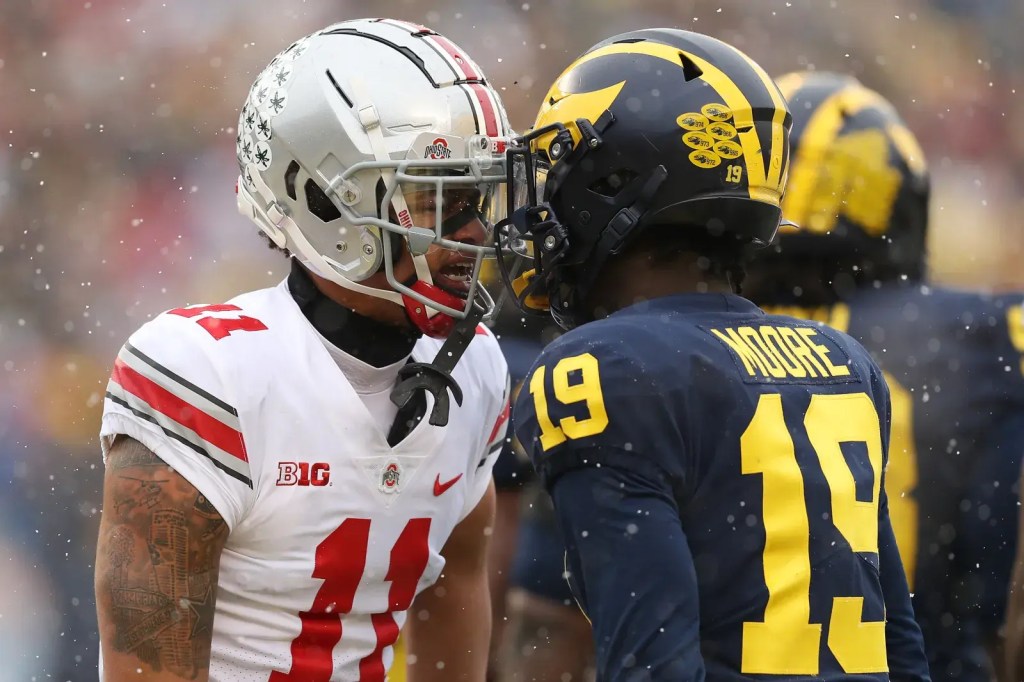
“The Game”—the rivalry between Michigan and Ohio State—arguably the biggest rivalry in college football, and possibly the whole world. The rivalry continues this weekend (11/29) in Ann Arbor, with Michigan having won the past four games against Ohio State, and leading the all-time record with 62 wins compared to Ohio State’s 52 victories. “The Game” is gushing and filled to the brim with iconic moments and backstories, from the Bo Schembechler and Woody Hayes battles in the 1970s, to the J.T. Barrett controversial fourth down conversion, the teams have had many iconic moments when put against each other.
This rivalry could be linked back to the two states physically fighting each other in the Toledo war in 1835 and 1836, with a border dispute over Toledo between the two states. This war was not really bloody at all, with militias firing at each other, a few people getting arrested, a Michigan sheriff getting stabbed, and the Michigan territory governor, Steven T. Mason, being removed from his governing role. Overall, a very bloodless war that ended with Ohio keeping Toledo but Michigan got the Upper Peninsula and Isle Royale. Michigan, however, got the last laugh with the Upper Peninsula being littered with copper, as electricity started to gain usage and popularity in the United States. While Ohio kept Toledo, which did nothing for them in the long run, Michigan became very profitable off the copper mines in the newly gained territory. So before the states were already at each other’s throats—exactly 61 years before the football rivalry started.
The Ten Year War was the nickname for the rivalry’s games in the 1970s between Bo Schembechler and Woody Hayes, the coaches of the schools. Michigan, under Schembeckler, won the Ten Year War with five wins, to Ohio State, under Woody Hayes, four wins and a tie in 1973, with that game being the most memorable because of its controversy. The issue was not the game itself, but who got to go to the Rose Bowl and therefore become national champions, with Ohio State getting to go. The way the process worked was the Big Ten athletic directors picked who went. Ohio State won the vote six to four, and the deciding vote went to Michigan State. Clearly, Michigan was upset with Michigan State, their other major rival, deciding who went to the Rose Bowl. Archie Griffin, a player on Ohio State that year, was asked about his thoughts on the 1973 controversy and Clevland.com reported that he said, “We played that game at Michigan and they didn’t beat us there.” So, while Michigan complained about how the vote was rigged, Ohio State claimed since they played in Ann Arbor and Michigan didn’t beat them. The Ten Year War came to a disappointing end with Woody Hayes being fired from Ohio State after punching a Clemson Player in the Gator Bowl in 1978 ,and that was the end of an iconic decade of the rivalry.
Another controversy came up in 2016 over a fourth down conversion by J.T. Barrett for Ohio State. It was fourth down in overtime, and the winner would be going to the Big Ten Championship and most likely the College Football Playoffs. If Michigan stops Ohio State they move on, and if Ohio State converts, they can score a touchdown and move on. Barrett kept it and took off and then the moment of the hour happened. A Michigan Linebacker hits Barrett, causing him to slip and crash into one of his blockers. Then, he goes down, and the refs said he got it. After the ball is placed, it all goes sideways, Harbaugh and Michigan believe he was short. After the booth review, the refs make the rule stand. Then the very next play, Ohio State runs the ball and scores a touchdown and wins. This call still haunts Harbaugh, even after winning a national championship. Isaiah Hole of the Wolverine Wire wrote, “Getting to the CFP and not winning that kind of thing, some of those games. 2016, coming up, we thought that measurement was short, the fourth down, we thought, Harbaugh said.” So, the event is still very fresh in Harbaugh’s and Michigan fans’ minds.
The Game has created some iconic moments, for better or for worse. Back in the 1973 game, Ohio State tore down the banner Michigan runs under and touches before the game. Then in 1977 when Ohio State tried to do the same thing and caused a fight, with Michigan players fighting them back from doing so. Also the voting situation in 1973 for the Big Ten champion and Rose Bowl. Then the iconic moment was Desmond Howard doing the Heisman stance in 1991 against Ohio State and then he won the Heisman that year. Another was the 2006 game being the highest scoring game combined with the winner becoming the national championship, with Ohio State winning 42-39 against Michigan. This was also a special game, being a day after Bo Schembechler died. Then the J.T. The Barret 2016 game was another iconic one. Finally, just last year, Michigan beat Ohio State 13-10, being 21 point underdogs and attempted to plant the Michigan flag. Jack Sawyer, an edge rusher of Ohio State, who never did beat Michigan, came storming in and took the flag and a whole brawl broke out. The brawl was so bad the Ohio police pepper sprayed Michigan players, but not Ohio State players. Although that did not change the fact that Michigan still beat them.
That whole ending was symbolic of how so many years ago, the Michigan territory was punished by the federal government over the Toledo War, and yet benefited the most with gaining the Upper Peninsula. Making this rivalry a full circle and why it’s the biggest rivalry in college football.
 Lyon Life